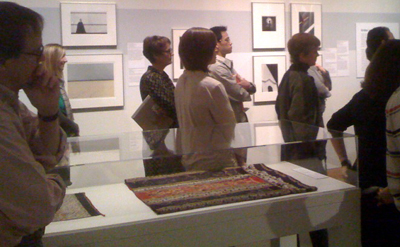
Staff on a tour of Pam McClusky's "Order and Border" collection installation today.
Photography inside a museum’s art galleries can be a touchy touchy issue. From conservation (yes, repeated “flashing” does damage art over time) to super serious legal matters (most 20th and 21st century art is under copyright by an artist or an estate), the issues surrounding the seemingly simple act of taking a picture are complex and abundant.
But even within the walls of our staid cultural institutions, we need to acknowledge the changing ways we all live within our world, and photography is a big part of that.
For months, SAM has been working hard behind the scenes, to research these issues and study the ways in which other institutions maneuver them. The goal: to pair our mandate to collect, care for and display works of art now and into the distant future with the desire of the public to document their personal experiences.
Today, SAM institutes a new photography policy that is much more lenient than it has been in the past. Photography is permitted in the galleries.
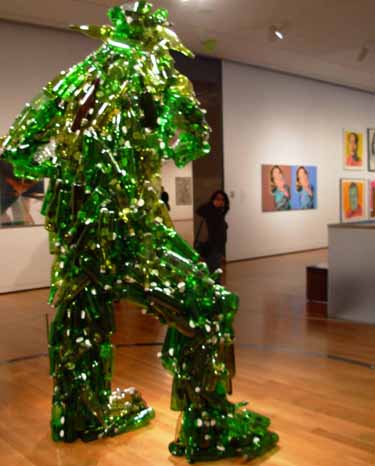
Le Semeur/Sunlight and Flies, 1984-2002, Jerry Pethick, Canadian, 1935 – 2003, Glass bottles, silicone, rubber corks, aluminum, surveillance mirror, 94 1/2 x 48 x 43 1/4in., Gift of the Parsons Family, the Benaroya Glass Fund and the Mark Tobey Estate Fund © Estate of Jerry Pethick
There are a few limitations, of course, all outlined on our website. For instance, some works from outside institutions are loaned to us with the specific caveat that they are not to be photographed. This includes all of our special exhibitions on the fourth floor. We must honor the wishes of our lenders in order to bring these significant, often quite amazing works to the Seattle public.
There’s a little bit more (no flash, no tripod), but we hope that for most of you, the new policy will open up a new way to experience SAM – and bring SAM home with you after a visit. Let us know how it’s working.
-Nicole Chism Griffin, SAM PR
Just wanted to say you have a great site and thanks for posting!
Totally digg your website thanks a lot for the info
I have waited years for this decision! There are so many permanent collection works I love that are not visually documented in any “official” SAM publication. Thank you so much for making this possible.
(…) OK good to see- new comments are always welcome! Peace. (…)
I’ve been looking for this exact information on this subject for a long time. Bookmarked and recommended!
I totally understand the need to protect the works of art from light, ie: flash cameras, and protect the artists from having folks copying their work, but as an art teacher I am really pleased with this decision. Several months ago my family visited SAM and there was a technique that I wanted to photograph to share with my students. I respected the rule of no photography, but now can’t wait to return to catch the image for them! Thank you–change is challenging, but oft times necessary.
I liked the posting & think that it will be helpful for others. Keep up the good work. Good luck.
Things are getting better and better this days especially with the notable efforts like SAM.
Photos are part of our lives nowadays, it surely make our lives easier .
Thank you for your policy change. I appreciate being able to take some photos in order to further reflect and gain more insight into the artwork. Hopefully I can encourage more of my friends to join me at the SAM.
Thank you so much! This decision is wonderful. You are to be commended for reviewing your policy and making it work for all.
JohnC: SFMOMA’s policy was definitely one we looked to as we were working through the feasibility of changing our policy. They’ve done a great job of puzzling through the hurdles of photography in museums.
Thanks for this update! SF MOMA has had a great policy around this and I am happy to see SAM stepping up with this.
Thanks!
Honestly, if a criminal is that intent on recording the security, they’ll find a way. Anyone can buy spycams these days.
I’m with the people on the provenance issue. I recently visited with a friend and we saw a very large painting of a woman in one of the rooms, and it could be the twin of a co-worker. I didn’t write down the name, though. When I wanted to tell her who did the painting and it’s title, it wasn’t anywhere on the website, and I had to call and get transferred 3 times before anyone could help me, although I could describe the painting, say which room it was in, and even where it was in the room. A simple cellphone photo of the placard would have saved everyone all that time just to share something that would make another person go to the museum to see a painting.
I am absolutely thrilled about this decision. This is a big help in educating people. It’s not all posing in front of the Van Gogh or humping a Rodin for a Facebook photo, some of us need to remember name and provenance (@ Timothy).
Photographs do for museums what their websites have been lacking – good visual coverage for studying art. Often times I’m dissapointed with museum websites (SAM included) who don’t have decent or full range shots of their work. When I want to study a piece in my own way, I need my own image!
Also – expect some photo-bombing (aka art bombing) at my website, andnowitsart.com, very soon.
Thank you! Can’t wait to make my way back to SAM!
From a security perspective this is a very bad idea.
Security Intrusion systems then can be videod and studied and make an easier job for art heists to occur.
It complicates security offciers job of preotecting a priceless collection.
Im 100% against it.
And I am a very keen photgrapher in my spare time, and understand it, and enjoy it.But in the art museum galleries, its a no no.
Thanks! I was just chastized the other day for taking an iPhone pic of the name placard to help me remember who the artist was. I’ve long been in the habit of snapping iphone photos of my favorite art as a note taking tool. Thanks for not making me a criminal!
Woohoo!! Thanks SAM!!
Thank you for making this change! Next time I visit I’m looking forward to bringing my camera with me.
Thank you so much for this change in policy. As you noted, the times are changing and it’s great that we here in Seattle have a museum that is willing to adapt and change in order to better serve visitors.